A Winter Woodland Walk for Reading Tree Silhouettes
A winter woodland walk for reading tree silhouettes helps you notice branching patterns and tree shapes at an unhurried pace, without collecting anything.
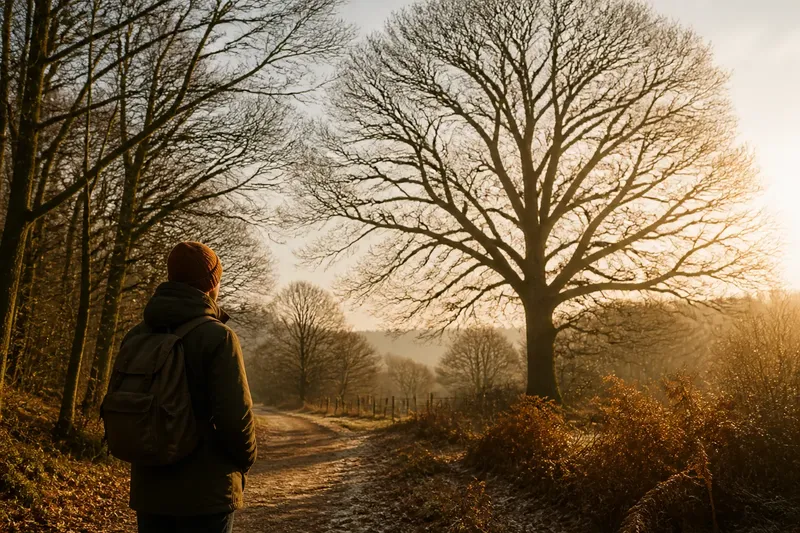
The common mistake on a winter woodland walk is to look up, name a tree if one comes to mind, then hurry on. That rush costs you the details that make one bare crown distinct from another: where its main limbs begin, how they divide, and the space they leave around them. A winter woodland walk for reading tree silhouettes works better when you choose a short route and give each tree a moment of attention.
You do not need a guidebook, a phone app or a sharp eye for every species. The aim is to notice patterns in familiar trees, not to identify every trunk with certainty. Keep to the path, take nothing, and let the changing shapes become the reason to slow down.
Where should you begin your winter woodland walk?
Choose a familiar, clearly marked path with a few open views into the trees. A woodland edge, a broad bend in the track or a clearing can show whole crowns against the sky; a dense stand may reveal only small pieces. Pick a route you can follow without concentrating on navigation, and avoid steep, slippery or exposed ground if conditions make it uncomfortable.
Before setting off, check the weather and local access advice. Wear footwear suited to mud or frost, and bring a warm layer. A small notebook and pencil are optional, but your hands can stay free if you would rather simply look.
At the entrance, pause where you can see several trees at once. Notice the general scene: are the crowns tall and narrow, broad and rounded, or irregular? Do most trunks stand singly, or do several stems rise close together? These first impressions give you a reference for comparisons farther along the path.
How do you read a tree’s overall shape?
Start with the outline, rather than trying to name the tree. Look from the top of the crown down to the trunk, then ask where the widest part sits. A tree that spreads broadly from low on the trunk makes a different silhouette from one that keeps a narrow, upright form.
Next, notice the main branches. Some rise in a fairly balanced arrangement; others lean, fork or reach more strongly to one side. Look for the height at which the trunk divides, whether the limbs angle steeply or stretch outward, and whether the crown ends in a clear point or a loose, uneven top.
It can help to imagine the crown as an umbrella. The outline tells you whether it is tall and closed, wide and open, or lopsided from the ground up. That simple comparison is not a species test; it is a way to hold the shape in mind long enough to notice its character.
What should you notice in bare branches?
Choose one tree and trace its branching pattern with your eyes. Follow a large limb from the trunk towards its tip. Watch where it divides into smaller branches, then see whether those branches keep dividing in a similar rhythm or take more irregular turns.
Compare the spaces between the limbs as well as the wood itself. A crown may look open because its major branches are widely separated, while another appears dense because many fine twigs fill the gaps. Against a pale winter sky, those empty spaces can be as distinctive as the branches around them.
Then look for repeated features: a fork that forms a broad V, a set of upward-reaching limbs, or a branch that curves before splitting. Avoid treating one unusual limb as the whole tree. Wind, shade, nearby trunks and past damage can all affect its shape, so read the overall arrangement rather than relying on a single clue.
How can you compare familiar woodland forms?
Move to a second tree of a similar size and compare just one feature at a time. First compare crown width. Then look at where the main branches begin, and finally consider how finely the tips divide. Keeping the comparison narrow makes it easier to see differences without turning the walk into a guessing game.
Imagine you pause beside two broad-crowned trees on a path. One has a high trunk division and open, outward-reaching limbs; the other branches lower and carries a denser mesh of fine twigs. You could note those visible contrasts, then look again from a nearby bend to see whether the silhouettes still differ from that angle. The result is a clearer description, even if you do not settle on a species name.
Try comparing trees in different positions, too. A solitary tree often shows its full outline, while a tree among close neighbours may grow more unevenly or reach into a gap. That contrast tells you something about form and setting together, without requiring you to explain exactly why each limb grew as it did.
What questions help you read a silhouette?
How can I tell an open crown from a dense one?
Look at the spaces between the larger limbs, then check whether fine twigs fill those gaps. An open crown leaves more clear sky within its outline; a dense one breaks the sky into smaller patches.
Why does one tree lean or spread to one side?
A lean or one-sided crown is a visible feature, not a reliable clue to a single cause. Nearby trees, exposure and past damage may all shape growth, so describe the direction and form without assuming what produced it.
Can I identify a tree from its winter silhouette alone?
Sometimes a familiar outline can suggest a likely tree, but bare branches are not always enough for a confident identification. Treat a name as a possibility and use the walk to practise noticing shape, branching and twig density.
What should I do if I cannot see the whole crown?
Choose one section that is visible, such as the trunk fork or a few major limbs, and describe what you can actually see. You can compare that section with another tree rather than forcing a judgement about the hidden outline.
How should you finish the route?
As you approach the end of the walk, revisit one tree you noticed earlier. See whether your attention now goes first to its outline, its main forks or the spaces between its branches. A second look can make a familiar tree feel more legible without requiring a more complicated method.
If you made notes, keep them about visible details: “low fork, broad crown, many fine tips” is more useful than an uncertain name on its own. Do not mark trees or remove twigs, buds or fallen material. The point is to leave the woodland as you found it and carry the observation away with you.
A winter woodland walk for reading tree silhouettes can be repeated on the same path as the light and weather change. On one visit, a crown may stand sharply against a bright sky; on another, mist or low cloud may soften its edges. Either way, a few patient comparisons are enough to make the branching patterns of familiar woodland forms easier to recognise next time.