Why Peat Builds Up in Waterlogged Ground
Why peat builds up in waterlogged ground: learn how slow decay lets plant remains accumulate, and how peat differs from ordinary soil development.
The common mistake is to treat peat as ordinary soil that has simply stayed soggy. That can obscure the process that makes it: in waterlogged ground, plant remains decay slowly enough for layers of partly preserved material to accumulate. Understanding why peat builds up in waterlogged ground helps explain why a dark, springy surface can tell a different story from mineral soil beneath a field or woodland.
What is peat, and how does it begin to form?
Peat is an accumulation of partly decomposed plant material formed where wet conditions restrict decay over a long period. It is not just soil with a high water content, nor is it simply a layer of loose leaves. Its plant remains have been altered by decomposition, but have not broken down completely into the more mixed material typical of many ordinary soils.
The process begins when plants grow and add stems, roots, leaves, moss or other organic matter to the ground. Some of that material dies and remains at or below the surface. If incoming plant matter continues to exceed the amount broken down and carried away, a deposit can gradually build.
In northern landscapes, peat-forming ground may include bogs, wet heath, fens and other persistently damp places. The plants differ from one habitat to another, so peat is not made from one universal ingredient. Mosses may be prominent in some places; sedges, grasses, roots and other plants can contribute elsewhere.
Why does water slow the decay of plant material?
Water fills the spaces between soil particles and plant remains. When the ground stays saturated, air moves into those spaces less readily. Many decomposers that break down dead vegetation work less effectively where oxygen is scarce, so plant material tends to decay more slowly than it would in well-aerated ground.
That does not mean decomposition stops. Organisms still transform the material, and some plant parts resist decay more than others. The important difference is the balance: if breakdown remains slow while plants keep adding organic matter, some of the material survives long enough to join an accumulating peat layer.
Think of a damp heap of leaves left in a closed container rather than spread loosely in a breezy garden. It is an everyday comparison, not an exact model, but it helps show why access to air affects how quickly plant remains change. In a peat-forming landscape, the wet conditions are not a brief spell after rain; they persist in the ground where the material is accumulating.
How do water levels and plants shape the deposit?
Peat formation depends on the conditions around the plant remains, not just on rainfall at the surface. Water levels that keep the ground saturated can limit aeration in the accumulating material. If the water table drops and the upper layer becomes drier, more air may enter and decomposition can speed up near the surface.
Vegetation also matters. Plants differ in how much material they contribute and in how readily their leaves, stems and roots break down. Their growth reflects local conditions such as water, nutrients and acidity. As a result, peat from one wetland need not look or behave exactly like peat from another.
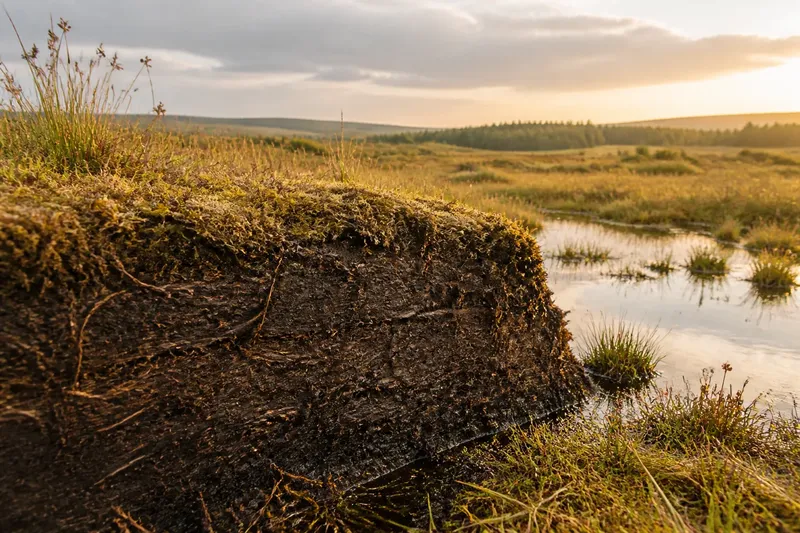
Imagine a small hollow where sedges grow and their dead leaves collect in wet ground. If the hollow remains saturated and new plant matter keeps arriving, older material may become buried beneath later growth and partly decomposed layers may accumulate. The observable clue would be a dark, fibrous deposit containing recognisable plant fragments, rather than a uniformly mixed mineral soil.
How is peat formation different from ordinary soil development?
Ordinary soil development commonly involves mineral material from weathered rock, organic inputs from plants and animals, and mixing by roots and soil organisms. The result varies greatly by place, but mineral particles are generally an important part of the soil body. Peat, by contrast, is distinguished by a substantial accumulation of partly decomposed plant remains.
The difference is not a strict split between “living” peat and “lifeless” soil. Peat supports organisms and changes over time, while ordinary soils also contain organic matter. The distinction is about the material that dominates and how it accumulated: peat builds when persistent wetness slows the loss of plant material enough for organic layers to form.
In a mineral soil, dead leaves may be incorporated into the surface and broken down or mixed with mineral particles. In peat-forming ground, plant remains can persist as a recognisable deposit instead. A spadeful may reveal fibres and fragments, but appearance alone can be misleading; moisture, vegetation and the surrounding landscape all help make sense of it.
What questions do people ask about peat?
Does peat form only in bogs?
No. Bogs are well-known peat-forming environments, but peat can develop in other persistently wet habitats, including some fens and wet heaths. The plant communities and water chemistry differ between places.
Is peat the same as humus?
No. Humus usually refers to decomposed organic matter within soil, while peat is an accumulated deposit in which partly decomposed plant material remains a defining component. The terms describe related organic materials, not interchangeable stages in every landscape.
Can peat form if the ground dries occasionally?
Temporary drying does not automatically rule out peat formation, but sustained saturation is central to the process. When the surface dries, added oxygen can increase breakdown in the exposed layer, changing how quickly material accumulates there.
Why can peat contain visible plant fibres?
Some plant parts resist decomposition, and wet, oxygen-poor conditions can leave fragments only partly broken down. Visible fibres are therefore consistent with peat, though they should be read alongside the wider setting rather than treated as proof on their own.
What can the surface tell you about peat-forming ground?
Plants, wetness and the feel of the surface offer useful clues when considered together. Sphagnum moss, sedges or other wetland plants may indicate suitable conditions, while a soft, water-retaining surface can point to organic material beneath. None of these signs alone identifies the full history or depth of a deposit.
Notice where water stands after rain, whether the ground remains damp in a dry spell, and whether plant remains are visible at exposed edges such as a natural bank or a path cut. Avoid digging into a wetland just to inspect it: disturbance can damage vegetation and alter water movement. A landscape viewed from its existing edges can still show how water and plant growth are shaping it.
Peat is easiest to understand as a record of an ongoing imbalance: plants add material, while persistent wetness slows its removal. This is why peat builds up in waterlogged ground and why it differs from ordinary soil development. On a walk, look for the combination of wet conditions, wetland vegetation and partly recognisable plant remains; together, they offer a more useful clue than a dark colour alone.