Granite or Sandstone: Reading Two Kinds of Stone
Granite or sandstone can look similar at a glance. Learn to read grain shape, mineral clues and cement to identify each rock more carefully.
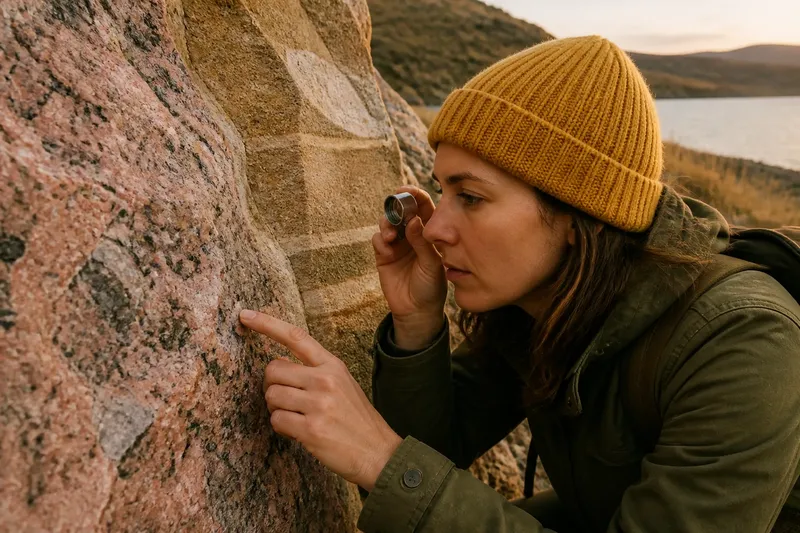
The common mistake when identifying granite or sandstone is to judge by colour alone: a pink surface may suggest granite, while a grey one can be mistaken for sandstone. That shortcut can send you towards the wrong story about how the rock formed. Look instead for the way its grains meet. Granite is built from interlocking mineral crystals; sandstone is made of sand-sized grains held together by cement or a finer matrix.
That difference is a useful starting point at a northern quarry face, a roadside cutting or beside a loch. You do not need specialist equipment to notice it. A hand lens can help, but careful observation of grain boundaries, shape and mineral mix often reveals more than colour ever will.
What does the surface tell you first?
Begin with a clean, unweathered patch if one is safely visible. Weathering can roughen a face, stain it with iron oxides, or remove softer material and leave a misleadingly uneven surface. Look across the rock rather than at one conspicuous fleck: a single pale crystal does not make a whole rock granite, just as one dark pebble does not turn sandstone into a conglomerate.
Granite commonly shows several mineral types fitted together like pieces in a mosaic. Pale quartz may look glassy, feldspar often appears cream, pink or white, and darker mica or amphibole can form small flakes or patches. The boundaries are usually crystal-to-crystal contacts, not a separate binder surrounding loose-looking particles.
Sandstone tends to show distinct grains, often rounded or angular, with a finer material between them. Quartz is common, though the rock may also include feldspar and fragments of older rocks. The grains can be easy to pick out, but sometimes they are so fine that a hand lens is needed. A rough, gritty feel can be a clue, although a hard, well-cemented sandstone may feel smooth.
How do interlocking crystals differ from cemented grains?
The distinction lies in the rock’s architecture. Granite crystallised as molten rock cooled underground. Its minerals grew in contact with one another, so their boundaries fit together. Different minerals crystallised under different conditions, which accounts for the varied colours and shapes across a single piece.
Sandstone began as sediment: grains were carried by water, wind or ice, then accumulated in layers. With burial, pressure brought grains closer and minerals precipitated from groundwater into the gaps, binding the sediment into rock. This binding material is called cement. Common cements include silica, calcite and iron compounds; some sandstones also contain clay-rich matrix between their grains.
Think of granite as a jigsaw assembled from crystals that grew against one another. Sandstone is more like a jar of grains whose spaces have been filled with a binder. The analogy is not exact: natural rocks are more varied, and sandstone grains can touch tightly. Still, it helps explain why a granite crystal boundary and a sandstone grain boundary mean different things.
Try tracing a boundary with your eye. In granite, a pale feldspar crystal may meet a darker mineral directly, with no obvious gap or coating between them. In sandstone, an individual grain may be outlined by a narrow rim or sit within a finer background. If the surface is too weathered to make that distinction, treat the identification as provisional rather than forcing a confident answer.
Which mineral clues are most useful?
Quartz is common to both rocks, so its presence alone does not settle the question. In granite, quartz usually forms irregular, glassy-looking patches between feldspar and darker minerals. In sandstone, quartz appears as separate grains, often with recognisable outlines. Their relationship to neighbouring material matters more than the mineral’s name.
Feldspar can also occur in both. In granite it is often a prominent crystal, sometimes showing flat faces or a cloudy, chalky surface where weathering has altered it. Sandstone may contain feldspar grains too, especially if the sediment did not travel far or was not strongly weathered before burial. Such grains can suggest relatively immature sediment, but they do not by themselves identify where it came from.
Dark minerals need care as well. Mica in granite may split into thin reflective flakes, while dark rock fragments in sandstone can be dull and irregular. Iron-rich cement can colour sandstone red, brown or yellow, but iron staining can also coat other rocks. Ask whether the colour belongs to a grain, a crystal or material filling the spaces around them.
What can grain size and arrangement reveal?
Granite crystals vary in size. Some specimens have a fairly even, medium-grained texture; others contain a few notably large crystals among smaller ones. Coarse crystals indicate that minerals had time to grow as the magma cooled underground, though texture alone does not tell you the full cooling history. Very fine-grained rocks may be other kinds of igneous rock, so do not call every speckled stone granite.
Sandstone grain size reflects the sediment that accumulated, while sorting and rounding offer clues about transport and reworking. Grains of similar size can give a fairly even texture; a mixture of sizes may make the rock look less uniform. Rounded grains have had their sharp corners worn down, while angular ones retain more of their original shape. These features point to the sediment’s journey, but no single grain shape gives a complete account of it.
Imagine you are examining a boulder with a pale pink background and dark flecks. You use a hand lens and see quartz and feldspar crystals meeting directly, with dark mica between them; that supports a granite identification. If instead you see separate grains with outlines and pink material between them, sandstone becomes more plausible. In either case, note the observations and keep the identification tentative if weathering obscures the texture.
What questions help distinguish granite from sandstone?
Can sandstone be made mostly of quartz?
Yes. Quartz-rich sandstone can look pale and uniform, but its quartz occurs as separate sediment grains rather than crystals interlocking with feldspar and mica. A lens can help reveal grain outlines and the material between them.
Does pink stone always mean granite?
No. Pink granite often gets its colour from feldspar, but sandstone can be pink or red because of iron-bearing cement, matrix or grains. Check whether the colour is inside crystals or around separate sediment grains.
Can I identify the rock from a photograph?
Sometimes a clear, close photograph shows the texture well enough for a tentative identification. Scale, lighting, weathering and image sharpness can hide grain boundaries, so a photograph is less dependable than a close look at the stone itself.
What if I cannot see any grains?
The grains may be too small, concealed by weathering, or absent because the stone is a different rock type. Examine another clean surface if available, and avoid treating an uncertain visual guess as a firm identification.
Why do the two rocks weather differently?
Weathering depends on the minerals, cement, cracks and local conditions, so neither rock has one fixed response. In granite, feldspar can alter into clay minerals while quartz often remains resistant; cracks may widen as water and frost work into the stone. The result can be a roughened surface with durable grains standing slightly proud.
In sandstone, the strength of the cement matters greatly. Silica cement can bind grains firmly, while weaker or more soluble cement may allow grains to loosen as water moves through the rock. A sandstone face can therefore shed grains or develop pits, but some varieties remain tough. Colour may change too, especially where iron compounds are altered or carried away.
These patterns are clues, not a field test of strength. A small weathered patch can differ from the interior, and a rock’s condition depends on its setting. If you are considering stone for a building, wall or other practical use, ask a qualified stone professional to assess the particular material rather than relying on its name alone.
How can you make a careful field identification?
Use these observations to decide what to do next; do not rely on any single clue:
- Check the surface: if you can see a clean patch without lichen, soil or staining, inspect it; if not, look for another safely visible face or record the identification as uncertain.
- Check the boundaries: if crystals meet directly, favour granite; if separate grains have outlines and sit in binder or matrix, favour sandstone; if neither pattern is clear, keep both possibilities open.
- Check the mineral mix: if quartz, feldspar and dark minerals form a connected mosaic, favour granite; if quartz or other grains sit separately, favour sandstone; if the mix is unclear, do not decide from colour alone.
- Check grain shape and size: if particles look like distinct rounded or angular sediment grains, favour sandstone; if they form differently shaped crystals fitted together, favour granite; if grains are too fine to resolve, use a hand lens or leave the name provisional.
- Check the spaces between particles: if you see cement or a fine matrix around separate grains, favour sandstone; if there are direct crystal contacts, favour granite; if weathering hides the spaces, inspect another face or describe only what is visible.
- Check for staining and weathering: if colour appears to coat the surface or fill gaps, treat it as a possible weathering clue rather than a rock identity; if colour lies within distinct crystals, record that observation but still check the grain relationships.
For any close inspection, follow the landowner’s access rules and local guidance; do not break material from an outcrop or take samples where this is prohibited. A useful field note is a plain description such as “pink and white crystals interlock” or “rounded quartz grains sit in a reddish binder”. That record makes your reasoning clear and lets you revisit the identification later.
For granite or sandstone, the most reliable clue is not a signature colour but the relationship between the particles. Once you can see whether crystals grew together or sediment grains were cemented, the surface becomes a record of the rock’s origin. When you search for granite or sandstone, note that relationship first; it is often more useful than a hurried label.